
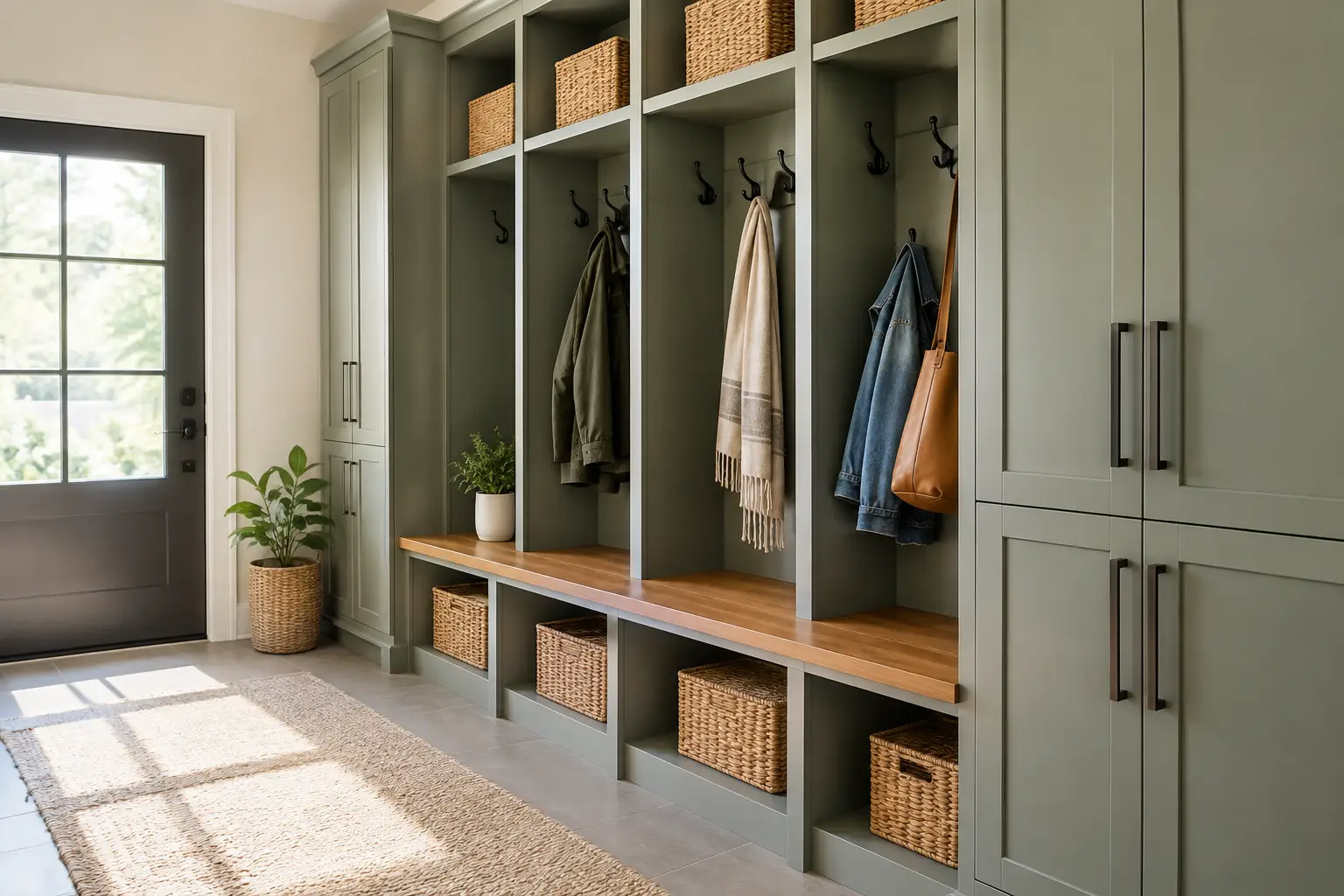
The entry door opens, the family arrives, and the floor becomes the default landing place for boots, backpacks, coats, sports gear, and dog leashes. Well-designed mudroom storage cabinets change that pattern. They give every daily item a considered home while making one of the hardest-working spaces in the house feel calm, finished, and easy to maintain.
A mudroom should not be designed around a generic cabinet layout. It should be designed around the people who use it, the weather they bring in, and the rhythm of the household. A family with young children needs reachable hooks and room for snow pants. A couple with an active dog may need washable surfaces, leash storage, and a place for muddy towels. Someone entering through the garage may need a charging drawer, a drop zone for mail, and cabinetry that transitions naturally into a laundry room or kitchen.
Separate wet arrivals from dry storage
The Cranbrook overview confirms mudroom cabinetry as part of a project that also includes the kitchen, bathrooms and laundry. It does not document every locker or wet-boot fitting. Use the room list as coordination evidence, then specify the entry storage for your own household.
Decide where wet footwear and outerwear dry before enclosing them. For any powered or charging feature, confirm the selected product and appropriate electrical work; a closed cabinet is not automatically a suitable charging enclosure.
| Contents | Daily condition | Decision to discuss |
|---|---|---|
| Boots and shoes | Wet arrivals and dry pairs | Drying place, tray care and storage dimensions |
| Coats and bags | Damp outerwear and everyday carry | Open access versus enclosed storage |
| Seasonal items | Occasional bulky storage | Reach and compartment size |
| Entry traffic | Doors, people and carried items | Clear path with cabinetry open |
For an adjoining utility space, coordinate the laundry and mudroom around machines, folding and supplies.
For wardrobe overflow, plan coat and hanging storage using the longest garments and the quantity to store.
Start With How the Entry Is Actually Used
Before selecting door styles or paint colours, look closely at the route through the room. Which door does the family use most often? Where do shoes come off? Does the space also serve as a laundry room, pantry overflow, pet station, or access point from the garage?
These answers determine the cabinet plan. A beautiful wall of closed cabinetry can look orderly, but it may be frustrating if children cannot reach their own coats or if wet boots have no place to dry. Conversely, an entirely open bench-and-hook arrangement can feel busy when it is holding a full season of outerwear.
The strongest designs usually balance accessible open storage with concealed storage. Open cubbies, hooks, and a bench handle the quick transition in and out of the house. Tall cabinets, drawers, and upper compartments contain the items that do not need to remain on display.
Give each person a defined zone
Individual lockers or cubbies prevent the familiar pile-up that happens when everyone shares one bench. The width of each zone depends on the household, but the purpose remains the same: one dependable location for each person’s coat, bag, footwear, and seasonal accessories.
For smaller children, hooks placed at their height encourage independence. For adults, a second, higher row of hooks can accommodate longer coats or provide overflow during winter. A built-in bench is more than a visual feature. It creates a comfortable place to put on boots and defines where footwear belongs.
Mudroom Storage Cabinets Need the Right Mix
The most useful mudroom storage cabinets are rarely made up of one cabinet type repeated across a wall. They combine several forms of storage so the room can accommodate both the predictable daily routine and the less frequent seasonal changeover.
Tall pantry-style cabinets are valuable for brooms, umbrellas, cleaning supplies, and bulky outerwear. Their interiors can be fitted with adjustable shelves, pull-out trays, or a hanging section, depending on what the home needs. Where space allows, a tall cabinet near the exterior door can also serve as a discreet utility closet for items that would otherwise migrate to the garage.
Base drawers work especially well beneath a countertop or beside a bench. Deep drawers can hold hats, gloves, dog supplies, reusable shopping bags, or sports equipment. They are often easier to use than deep cabinets because the full contents come forward rather than disappearing at the back of a shelf.
Upper cabinets earn their place when the mudroom has enough ceiling height and the family has items that should be stored out of sight. Holiday accessories, off-season gear, and extra household supplies are good candidates. Keeping these cabinets aligned with adjacent kitchen or laundry cabinetry can make a transition space feel intentional rather than added on.
A thoughtful mudroom may include:
- Open cubbies and hooks for everyday arrivals and departures
- A bench with durable seating and shoe storage below
- Full-height cabinets for coats, cleaning tools, and seasonal gear
- Drawers or pull-outs for small items that tend to get lost
- Upper cabinets for infrequently used supplies
The exact combination depends on the room. In a narrow hallway, a shallow cabinet depth and a streamlined bench may preserve a comfortable passage. In a larger rear entry, a full wall of cabinetry can become a substantial organizing centre for the household.
Choose Materials for Wet, Busy Conditions
Mudrooms see more moisture, impact, and abrasion than many rooms in the home. Boots scrape against toe kicks. Wet jackets brush cabinet sides. Bags are dropped, hooks are pulled, and bench surfaces carry a surprising amount of weight over time. Materials and finishes should be selected with that reality in mind.
Painted cabinetry offers flexibility and can connect the mudroom to the home’s kitchen, trim, or architectural palette. A deeper painted colour is often practical around a busy entry because it is more forgiving of everyday marks than a pale finish. That does not mean light cabinetry is off the table. It simply benefits from a durable, well-applied finish and a plan for regular care.
For the bench, consider the feel as well as the durability. A solid wood seat can add warmth against painted cabinetry and can be finished to stand up to daily use. A stone or durable solid-surface top may be a better fit where wet gear is routinely set down. The surrounding flooring also matters. The cabinetry should meet the floor with a detail that is easy to clean and does not trap grit or moisture.
Hardware deserves the same attention. Hooks need to be securely anchored and selected for the weight they will carry. Knobs and pulls should feel comfortable in the hand and complement the hardware used elsewhere in the home. Small decisions like these are what help custom millwork feel cohesive and dependable for years.
Make Room for the Things That Do Not Fit a Cubbie
Every household has awkward essentials: hockey bags, tall rubber boots, backpacks, dog food containers, vacuum attachments, or a folding stroller. These are often the items that reveal whether a mudroom was planned carefully or simply furnished with cabinets.
Measure these items before finalizing the design. A cabinet intended for a vacuum needs the correct interior height. A bench cubby for boots needs enough depth to prevent footwear from projecting into the walkway. If pet food is stored in the room, a ventilated pull-out or a dedicated lower cabinet may keep it accessible without making it part of the visual clutter.
Electrical planning is equally useful. A concealed outlet inside a cabinet can create a charging location for cordless vacuums, tablets, or rechargeable tools. A drawer with power can keep family devices from collecting on the kitchen counter. These details are easiest to incorporate during the design stage, before cabinetry is built and installed.
Consider seasonal flexibility
A mudroom that works in July may fail in January if it has no capacity for heavier coats, boots, and wet accessories. Adjustable shelves, removable bins, and a mix of hook heights help the room change with the seasons. It is also wise to leave some breathing room. Cabinetry filled to its limit on day one has little capacity for a growing family, new activities, or visiting guests.
Let the Mudroom Belong to the Rest of the Home
Because mudrooms are often tucked beside a garage, laundry room, or back entrance, they can be treated as purely functional. Yet this space is also a daily first impression of home. It deserves the same care in proportion, finish, and detailing as the kitchen or family room.
Cabinet door profiles can echo nearby built-ins or kitchen cabinetry without needing to match exactly. A simple shaker door, tailored slab front, or more detailed painted profile can all work when the scale suits the house. Wood accents, such as a white oak bench or walnut shelf, can add warmth and make the room feel less utilitarian.
Lighting should support both function and atmosphere. Good overhead light helps during dark mornings and winter evenings, while integrated lighting within a tall cabinet or under an upper shelf can make the cabinetry more useful and refined. If the mudroom includes a window, the layout should preserve natural light rather than covering it with storage by default.
For homeowners planning a renovation or custom build in Chatham-Kent, Windsor, LaSalle, or Sarnia, a carefully measured cabinet plan can turn an overlooked entry into one of the most appreciated spaces in the house. The value is not just in having more storage. It is in having storage that reflects how the household actually lives.
The best mudroom is the one that makes leaving easier, arriving calmer, and cleanup less of a daily negotiation. Start with the items that currently gather by the door, then give each one a place that is durable, accessible, and thoughtfully built to last.