
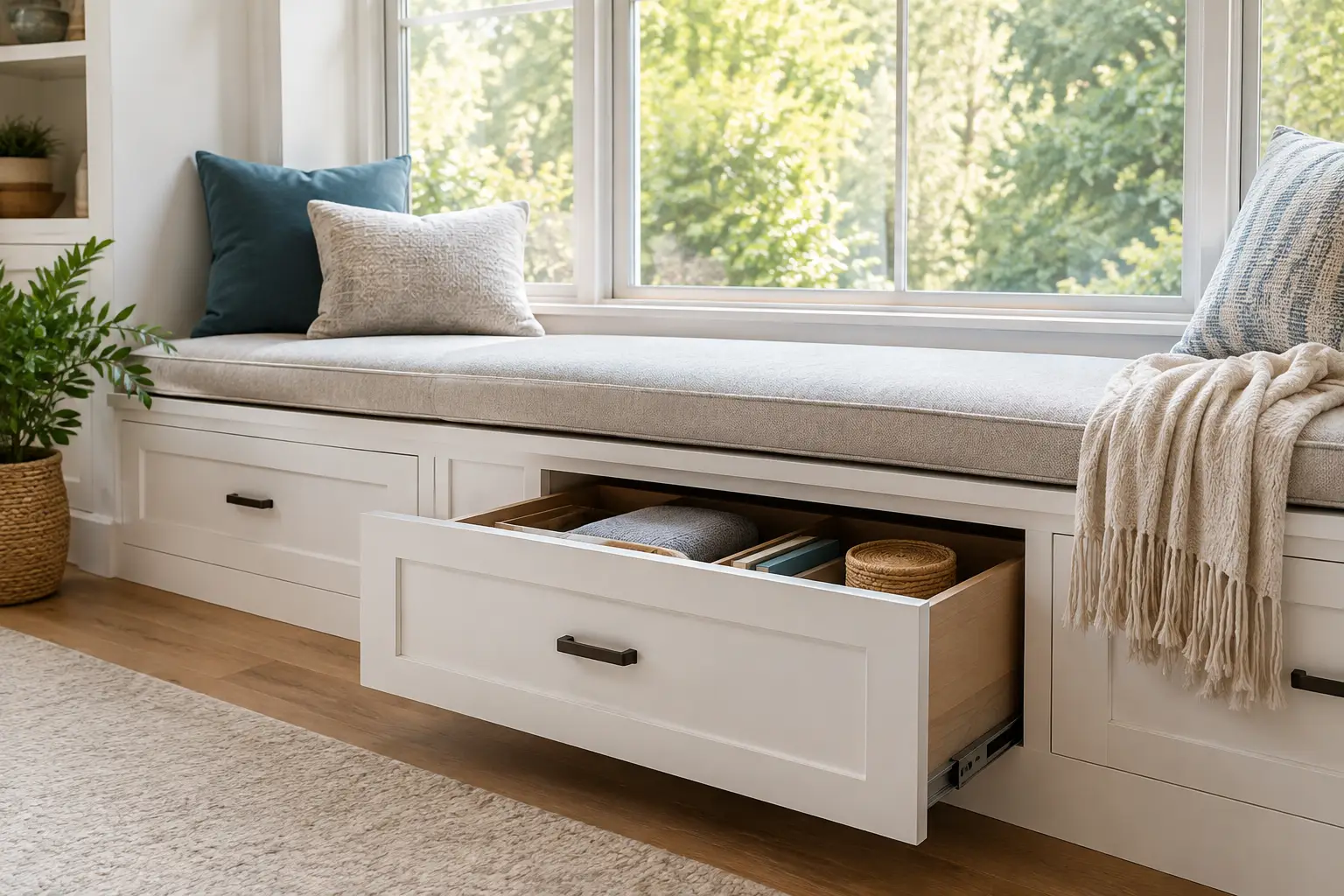
A window seat should earn more than a beautiful view. Thoughtfully planned built in window seat storage turns an underused wall into a place for reading, gathering, putting on boots, or simply enjoying the light – while keeping the belongings that tend to migrate through a home close at hand.
The best versions feel like they have always belonged there. Their proportions relate to the window trim and nearby cabinetry, the finish carries through the room, and the storage is easy enough to use that it actually stays organized. Getting there requires more than building a box below a window. It requires a clear understanding of how the room works, what needs to be stored, and what the home can support behind the finished millwork.
Viscount: three drawers beneath the window bench
The Viscount built-ins pair bookcases with a window bench containing three drawers. The project specifies face-frame inset cabinetry, Swiss Coffee paint and maple tops and nosing. Vented base trim and duct integration are also recorded.
Drawer access means the storage can be reached from the front rather than by lifting a cushion and hinged lid. That is a design comparison, not a claim about tested seating loads. Seat height, depth, cushion thickness and support need individual review; a general seat-height range is only a starting point for discussion.
| Question | Record | Check in the room |
|---|---|---|
| Comfort | Who uses the seat and the proposed cushion | Trial height and usable depth |
| Storage | Largest items and access frequency | Drawer travel or lid access |
| Window | Trim, sill and operating parts | Reach and opening |
| Services | Heating, vents and access | Required clearances and removable details |
If the window is beneath the roofline, consider storage beneath a sloped ceiling before fixing the bench and adjoining cabinetry.
Where the bench joins existing woodwork, coordinate cabinetry with existing trim using physical samples.
Why a Window Seat Is Worth Building
A window seat solves two needs at once: it gives a room a defined place to settle in and creates storage without adding another freestanding piece of furniture. In a breakfast nook, it can replace several chairs and hold table linens, serving pieces, or seasonal décor. In a living room, it offers a quiet perch while keeping throws, games, and extra pillows out of sight.
Bedrooms and children’s spaces benefit differently. A seat beneath a window can hold out-of-season clothing, books, or larger toys that do not fit neatly on open shelving. Near an entry, it becomes a practical landing spot for changing shoes, with storage below for footwear, bags, and cold-weather gear.
The value is not simply in gaining cubic feet. A custom seat can make an awkward alcove useful, soften a long wall of windows, or give a large room a more intentional focal point. The trade-off is that it takes up floor area permanently, so it should be designed around a genuine daily need rather than added only as decoration.
Planning Built In Window Seat Storage Around Daily Life
The first design decision is not the cushion fabric or door style. It is deciding what the seat needs to hold. Storage designed for a few throw blankets has very different dimensions, access requirements, and hardware than storage meant for sports equipment, board games, or a family’s winter boots.
Start With Comfortable Dimensions
A finished seat height of roughly 18 to 20 inches can be a discussion starting point, not a universal comfort rule. Try the proposed height with the intended cushion and the people who will use it. Depth matters just as much. A shallow seat may look refined but will not feel useful for lounging; a deeper bench is more comfortable yet can reach too far into a narrow room.
Window height also needs careful review. If the sill sits low, the seat may need to be built below it or the window opening may require a different trim approach. If it sits high, the resulting back wall can feel less inviting unless it is balanced with cushions, panelling, or adjacent built-ins. The goal is to preserve both the window’s function and its visual importance.
Choose Storage Based on What Goes Inside
Lift-up lids provide uninterrupted storage volume and work well for bulky, infrequently used items. They are a strong choice for blankets, holiday décor, or larger toys. However, a hinged lid requires a clear area above it, and anything on the cushion must be moved before the compartment can be opened.
Drawers are usually better for everyday use. They bring contents forward, make smaller items easier to sort, and avoid disturbing the seat above. Check the selected drawer hardware’s load information, usable dimensions and installation requirements against the items to be stored.
Cabinet doors are useful when the bench is deep or when the seat is part of a broader wall of cabinetry. They can be finished to match surrounding millwork, but access is less convenient when furniture sits directly in front of them. In some rooms, a combination works best: drawers for daily items and a lift-up compartment for occasional storage.
Account for the Things Behind the Wall
A window wall may contain electrical outlets, baseboard heating, supply vents, plumbing, or structural framing that affects the design. Covering a vent or restricting airflow can create comfort issues and may affect the heating system’s performance. A properly planned grille, an alternate vent route, or a revised layout may be needed.
This is also why a built-in should not be treated like a simple furniture project. The cabinetry must sit level, be securely fastened, allow for the home’s trim details, and leave appropriate access where mechanical systems require it. A site review before fabrication can reveal access and fitting concerns before the finish work begins.
Construction Details That Make the Difference
A window seat carries people, cushions, and stored items, often all at once. The internal structure needs to be sturdy enough for that load. Ask how the proposed materials, support and attachment suit the intended seating and storage loads. The support detail needs review for the actual installation.
The face treatment should reflect the room. A painted bench with recessed panels can relate naturally to a classic kitchen or mudroom. Clear-finished white oak or walnut brings warmth to a more contemporary living area. In a home with existing custom cabinetry, matching the door profile, paint colour, sheen, and hardware creates a result that feels planned rather than added later.
Finish durability deserves attention as well. Window seats are touched often, and entry benches see more than their share of wet shoes and dropped bags. A durable finish, wipeable cushion fabric, and carefully selected hardware help the space look composed after real family life has taken place there.
Cushions should be treated as part of the design, not an afterthought. A thick cushion is inviting but raises the seated height. A tailored cushion with a firm, high-quality foam core usually holds its shape better than a very soft option. Where sunlight is strong, choose fabrics with appropriate fade resistance and consider whether removable covers would be practical for the household.
Make It Part of the Room, Not a Standalone Box
The most successful window seats connect visually to their surroundings. A breakfast-nook bench might continue the kitchen’s painted cabinetry along one wall, with a wood tabletop that echoes the island. In a family room, the bench may be framed by bookcases and finished with a simple wood top that complements the flooring.
Symmetry can be beautiful, but it is not mandatory. A window offset from the centre of a wall may call for a seat that extends farther on one side, perhaps meeting a tall cabinet or an open display shelf. Designing around the actual architecture is more convincing than forcing the room into a perfectly mirrored composition.
Lighting can improve function and atmosphere. Nearby sconces make a reading seat more useful at night, while interior drawer lighting can be helpful in a deeper storage bench. These details need to be coordinated early so wiring is concealed and switch locations make sense.
When a Window Seat May Not Be the Right Choice
A built-in bench is not automatically the best answer for every window. In a very narrow hallway, the depth needed for a comfortable seat may compromise circulation. In rooms where the window must serve as emergency egress, its operation and accessibility cannot be obstructed. Moisture concerns around older windows also need to be addressed before enclosing the wall below.
Sometimes a lower cabinet, a freestanding bench, or a pair of shallow bookcases will offer more practical storage with less impact on the room. Good design includes knowing when to preserve open floor space and when a substantial built-in will genuinely improve the way a family lives.